
| Category | Total Knee Replacement |
The system is an advancement in the way orthopedic surgeons perform partial and total knee replacement. Every procedure has an individualized plan based on each patient’s unique anatomy. The system works in conjunction with the surgeon’s skilled hands to achieve precise positioning of components during surgery. This level of accuracy can help improve the function, feel, and potential longevity of the knee implant.
The system provides robotic assistance through an advanced computer program that relays precise information about your knee to a robotics-assisted handpiece used by the surgeon during the procedure. By collecting patient-specific information, boundaries are established for the robotics-assisted handpiece so the surgeon can balance your joint and position components with accuracy and precision.
The NAVIO Surgical System is a tool your surgeon used to correctly size and position the total knee implant with computer and robotic assistance.
Computer assistance is used to collect the unique shape and motion of your knee to virtually plan the procedure. Robotics assistance is used to accurately perform the procedure. The extra layer of planning and precision provided by the NAVIO system aims to ensure the procedure is performed exactly as you intend. The NAVIO system does not perform the procedure. Rather it assists your surgeon by providing accuracy and precision-crucial to the success of the surgery.
You will first be placed under anesthesia to relax your body for surgery and block pain. The correct form of anesthesia will be discussed and determined prior to surgery with your surgeon anesthesiologist.
Your surgeon will then make an incision that extends several inches above the knee cap to several inches below the knee cap. Using NAVIO system, special trackers are secured to both the thigh bone (femur) and shin bone (tibia) with four small surgical pins. It is placed through tiny incisions in the skin. These trackers are crucial to the precision of the system as they provide a constant reference point to the surgeon throughout the procedure.
Using computer assistance, the unique shape and motion of your knee are collected by the surgeon. This allows for a three-dimensional model of your knee to be generated and used by the surgeon to plan the procedure. Proper implant size and position will be determined at this time.
Once your surgeon virtually determines the correct implant size and positioning, a handheld robotics-assisted tool(the NAVIO handpiece) is used to accurately position bone removal cut guides. These cut guides enable the surgeon to use a surgical saw to remove your damaged knee bone, Making room for the implant. The extra layer of precision provided by the NAVIO system is designed to enable accurate cut guide placement. The NAVIO system does not perform the procedure. Rather it assists your surgeon by providing accuracy and precision – crucial to the success of the surgery.
Once the implant is in the final position, the incision is thoroughly cleaned and closed, Completing the procedure.
Other robotics-assisted surgical platforms require a costly CT scan. It exposes patients to unnecessary radiation equivalent to 48 chest radiographs.
Partial knee replacement offers several benefits over total knee replacement, such as less pain, more normal feelings knees, smaller incisions, and quicker rehabilitation.
Total Knee replacement is one of the most successful procedures in all of medicine according to the American Academy of Orthopaedic Surgeons. Over 90% who undergo the procedure experience a dramatic reduction in knee pain and a significant improvement in their ability to perform common activities.
Ask your surgeon:
The highest level of proficient care is provided for all knee problems viz. Total knee replacement and knee arthroscopy.
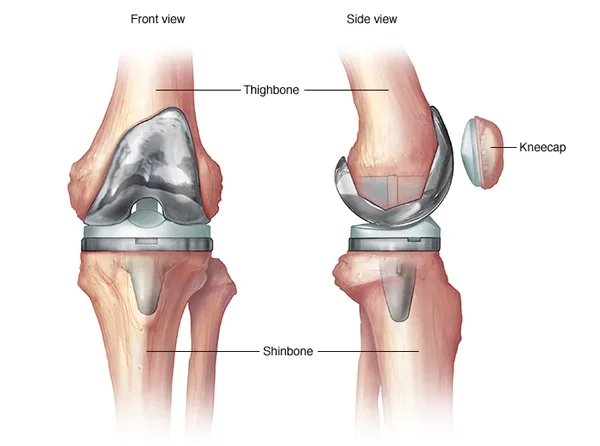
Knee replacement surgery — also known as knee arthroplasty — can help relieve pain and restore function in severely diseased knee joints. The procedure involves cutting away damaged bone and cartilage from your thighbone, shinbone, and kneecap and replacing it with an artificial joint (prosthesis) made of metal alloys, high-grade plastics, and polymers.
In determining whether a knee replacement is right for you, an orthopedic surgeon assesses your knee's range of motion, stability, and strength. X-rays help determine the extent of the damage. Your doctor can choose from a variety of knee replacement prostheses and surgical techniques, considering your age, weight, activity level, knee size and shape, and overall health.
A total knee replacement is a surgical procedure whereby the diseased knee joint is replaced with artificial material. The knee is a hinge joint that provides motion at the point where the thigh meets the lower leg. The thighbone (or femur) abuts the large bone of the lower leg (tibia) at the knee joint. During a total knee replacement, the end of the femur bone is removed and replaced with a metal shell. The end of the lower leg bone (tibia) is also removed and replaced with a channeled plastic piece with a metal stem. Depending on the condition of the kneecap portion of the knee joint, a plastic "button" may also be added under the kneecap surface. The artificial components of a total knee replacement are referred to as the prosthesis.
The posterior cruciate ligament is a tissue that normally stabilizes each side of the knee joint so that the lower leg cannot slide backward in relation to the thighbone. In total knee replacement surgery, this ligament is either retained, sacrificed, or substituted by a polyethylene post. Each of these various designs of total knee replacement has its own particular benefits and risks.


